
Interview: M.C. Taylor (Hiss Golden Messenger)
“If I have to choose between hope and despair, I’m going to choose hope.”
Such a statement might ring hollow coming from most artists. But from M.C. Taylor, whose Hiss Golden Messenger songs have long wrestled with the nuance of faith and fragility, it lands almost as a hard-fought testament. It’s also the thread running, subconsciously, through his latest album.
“This concept of ‘realistic hope’ is not something I was thinking about as I was writing, but it does seem like a theme under which a lot of the songs on I'm People have gathered,” Taylor explains. “I'm not talking pie-in-the-sky stuff. I'm cognizant of what the planet feels like it's up against.”
Co-produced with Josh Kaufman and recorded at Dreamland, a decommissioned church outside Woodstock, N.Y., the songs came together in layers and with subtle but additive contributions from a talented cast of friends. Bruce Hornsby, Sam Beam (Iron & Wine), Marcus King, Sara Watkins (Nickel Creek; I’m With Her), Eric D. Johnson (Fruit Bats; Bonny Light Horseman), Taylor Goldsmith and Griff Goldsmith (both from Dawes), and others lend a hand to Taylor’s compositions.
Asheville Stages spoke with Taylor from his home in Durham, where he was enjoying a few weeks off between legs of a nationwide tour that makes its next-to-last stop of 2026 at The Orange Peel on Thursday, Nov. 19.
Jay Moye: You released I'm People in May but didn't hit the road right away like you have in the past. How does it feel to let the songs marinate with your audience, so that by the time you're on the road, they're more known?
M.C. Taylor: That part is great because it's given people time to find their way into the music. A lot of times the music on albums doesn't follow the path you think it's going to follow. It doesn't matter how much publicity is pushing a certain song, or how much a label is working a certain angle on a record. Sometimes there are songs that just connect with people, because that's how the world works. A lot of people are singing along to songs I'm not sure they would have had time to learn had we not waited a couple of months. And I'm also seeing people connect to certain songs in ways I hoped for, but it was unclear what was going to connect.
JM: It looks like "Mercy Avenue,” in particular, has taken on a new life live. Did you predict or expect that?
MT: Not at all. That certainly wasn't a single off the record. But it does have an emotional thing to it, and when I saw people connecting with it, singing along at the end, I can't say I was surprised. I guess I was happy about it. But it's sort of the natural order of things.
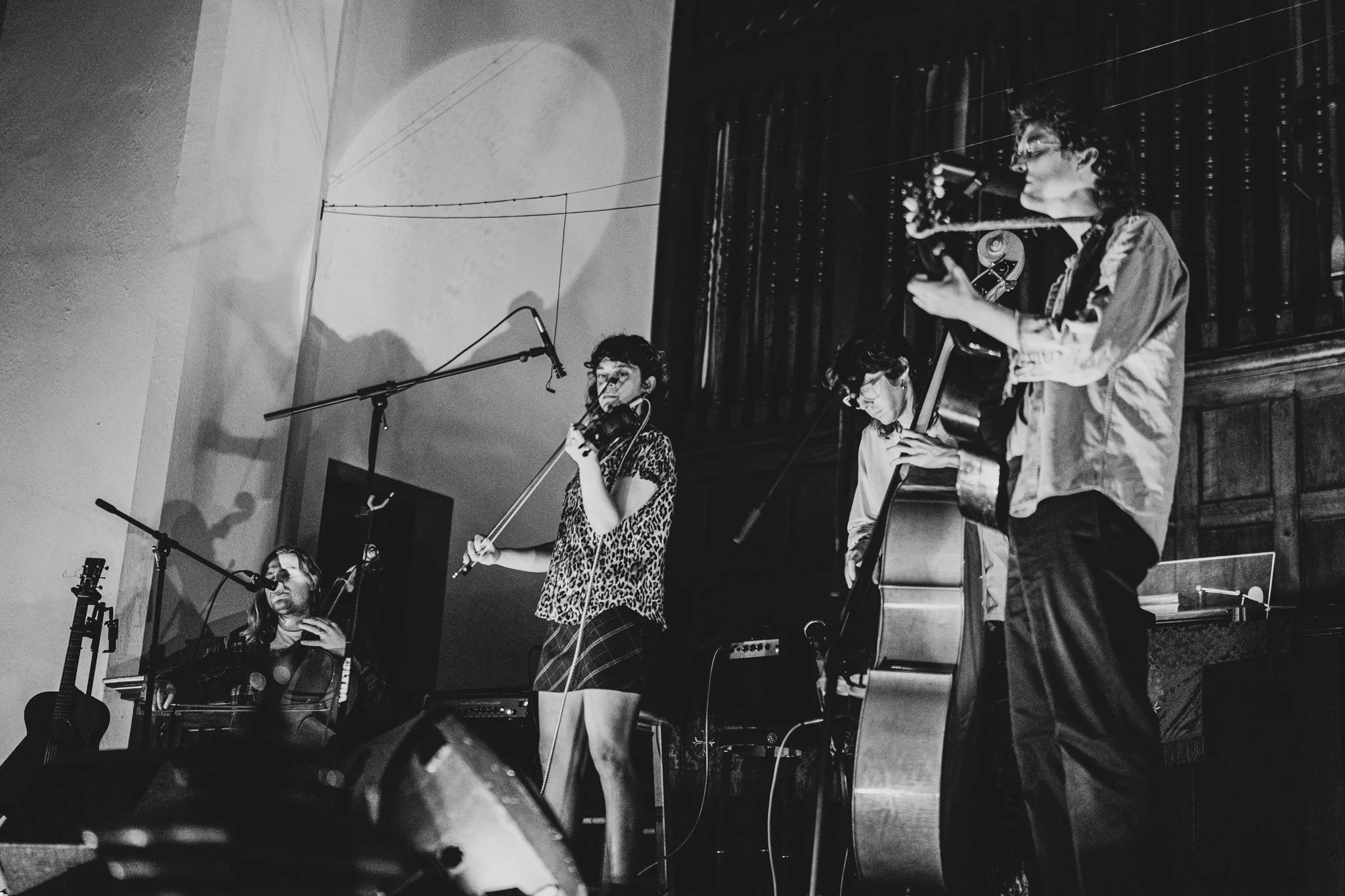
JM: It looks like you've got a mostly new band out with you, aside from [lead guitarist] Chris Boerner. How has it felt bringing these new songs out into the wild, from the studio to the stage?
MT: For people who are new to Hiss, or who haven't followed us super closely, the band may seem new. But in a funny sort of way, this is the most O.G. band I could have assembled. Matt McCaughan has played drums on almost every Hiss Golden Messenger record, even if he hasn't toured with us.
He was one of the two drummers of Bon Iver for many years. It's not like I was competing with Bon Iver. Obviously, Bon Iver is going to win out every time I'm sharing a musician. But as Bon Iver has moved into a new phase, a new era — whatever Justin [Vernon] is doing with that project — Matt has a little more flexibility. He’s always been my first-call guy.
The same goes for Cameron Ralston, who’s been playing bass — a dear friend of mine from Richmond. We have another project together called Revelators. Cameron and I have done years and years of work together. He's been coming out on the road with me since maybe 2014, just not on long tours generally.
And Chris Boerner is a guy everybody has seen on stage with me for a really long time. So really, the only new person is Rhett Huffman, playing keys. He started playing with us around the time we were doing the shows with the symphonies [fall 2025]. He lives in Atlanta, and he's an amazing musician and a real joy to have out on the road.
JM: When we last chatted, you'd just put out Jump for Joy, which was recorded at Sonic Ranch in Texas. I'm People was tracked in a much different environment. How would you describe the way those settings shaped the recordings that ultimately materialized?
MT: Because I was present at the recording of them, I always feel like I can feel the landscape in those records. But I think that's probably a personal thing.
JM: I think it comes through, though. I hear the desert in Jump for Joy, and I hear the bucolic setting of the Hudson Valley in I’m People.
MT: I don't know that choosing the area around Woodstock to make this latest record was a reaction to Jump for Joy. It had more to do with the fact that I was working with my buddy Josh Kaufman. He lives in Kingston, New York, very close to the studio where we recorded. He’s worked there a lot. He didn't have to do any arm-twisting to get me to come up there to make a record. I love that part of the world and it has played an important role in so much of my favorite music.
We did talk a lot about being in touch with those spirits up there. I feel like we got some of that Catskills magic on I'm People. My connection with that place, in terms of making records, is really just starting. I’d love to make another record up there.
JM: You had a number of guests show up to play on this record. Was that always part of the plan, or did it happen organically via Josh?
MT: We were generally looking for fellow travelers who could help us create this tapestry. For one thing, all the guests are friends. There weren't any strangers on the record. Anyone we asked to participate, we were consciously asking them to pull in the same direction we were. We felt like we were creating something special, and we didn't want there to be any distractions. So, asking Marcus King to sing, or Bruce Hornsby to play piano — we weren't telling them not to do anything. We were just asking them to participate in this art project we were making. And part of that requires you to listen and see where we're at with it. It was always really easy to slot in everyone's different parts.
JM: Speaking of Hornsby, he played and sang on"Pontiac," a B-side you released a few months after Jump for Joy came out. Tell me about the decision not to include it on the record.
MT: It has a slower tempo. It’s such a complicated dance, a balancing act, for me to get the overall tempo of a record right. At the time we were sequencing the version of I'm People that came out, I was really struggling to figure out where "Pontiac" would live.
The other thing about that song is that it just wasn't done. There was a bunch of stuff we needed to do, even after I'm People came out, to make it feel like it was finished.
JM: Your songs have seemingly always asked questions of yourself. What questions is I'm People asking?
MT: I'm not sure I've articulated it quite this way before, but one question this collection of songs is asking is, “Are you prepared to do the work alongside other people, which can sometimes be very uncomfortable, in order to try to create a better world?”
It's always been very easy and familiar for me to go into my solitary space, but I'm not always sure that's the best place for me to be. That goes for my relationship to other people when I'm making music, when I'm raising my children, and being around my family. It goes for every aspect of my life.
JM: The tone and tenor of your writing in your last three albums — from Quietly Blowing It [2021] to Jump for Joy to I'm People — seems to channel a gradual ascension of energy. How would you describe your headspace and heart space when you were writing this record, compared to the prior few? There's a cautious optimism, at least to my ears.
MT: The term I've been using when talking about this record is "realistic hope." I'm feeling more conscious than ever of the fact that the world we're hoping for, for our children, we may not live to see. But that doesn't mean it's not worth working toward. I have a song on I'm People called "Heavy World," and the chorus goes: "Heavy world, keep on suffering, we're suffering now. It ain't over.” Meaning, we may suffer and disappear from the face of the earth, but the world is here and will continue.
JM: That seems to be the message of the title track, that we're all in this together and need each other to push through.
MT: It's tricky to write hopefully underneath the chaos that seems so present, but it's not impossible. I feel like my job, at least with this past collection of songs, has been to keep it intimate. I'm not trying to write big songs for big groups of people. I'm trying to keep things small and understandable and personal, and digestible and specific to myself.
JM: I feel like I'm hearing more color and specific detail than in your prior work. Is it common for you to bring songs to life as you're traveling? Or do you usually write at home?
MT: I generally write at home, because that's where all the tools I've told myself I need to have around are. But I was feeling compelled to go elsewhere, to see what might shake loose. I don't know that I would have written the songs I wrote in Santa Fe or Bolinas, California, in quite the same way had I been at home. Any new stimulus can give birth to something new that wouldn't have come to you in a familiar place or state of mind.
JM: You've gradually built out a home studio. In addition to your own writing and recording, you're working with folks like Lou Hazel. Has it always been part of your plan to produce or engineer music, or is that a more recent development?
MT: I don't think I ever had it on my list to be a capital-P Producer. If I were, I think I'd be unhappy just being a jobbing producer, taking whatever clients came my way. I have to have a really personal connection to the music.
The [forthcoming] Lou Hazel record, for me, was an obvious one, because he's a dear friend. I adore his songwriting and really love him as a person. Because of all those reasons, and because of how deep into music I've been for so many decades, I felt like I knew exactly what his record should sound like. I can go into a production situation with that energy, though it's totally collaborative. I'm happy for any ideas I have to be tossed. I'm not really precious about it and don't generally take that kind of thing personally.
There are some projects where I can really envision myself as the captain of the ship. Other times, there might be a project where I adore the songwriting and the music but feel like someone else could probably do it better than me. There's definitely stuff I've turned down, not because I didn't like it, but because I felt there was someone out there who could give it the energy it needs. I don't ever want to go into a project and half-step it.
JM: Does working with artists like Lou, from the engineering or producer seat, channel back into your own art?
MT: Totally. You get to witness how someone else does it, and it can make you go, "Whoa! I've never done it like that. That's awesome." Or you get to see someone else struggle in the same way you do, and it can give you a sense of relief,” OK, this is work. We’ve just gotta put the reps in.” That's the only real way.
IF YOU GO
Who: Hiss Golden Messenger with Sam Amidon
When: Thursday, Nov. 19, 8 p.m.
Where: The Orange Peel, 101 Biltmore Avenue, theorangepeel.net
Tickets: $40.42
(Photo by Graham Tolbert)