
Interview: Lou Hazel
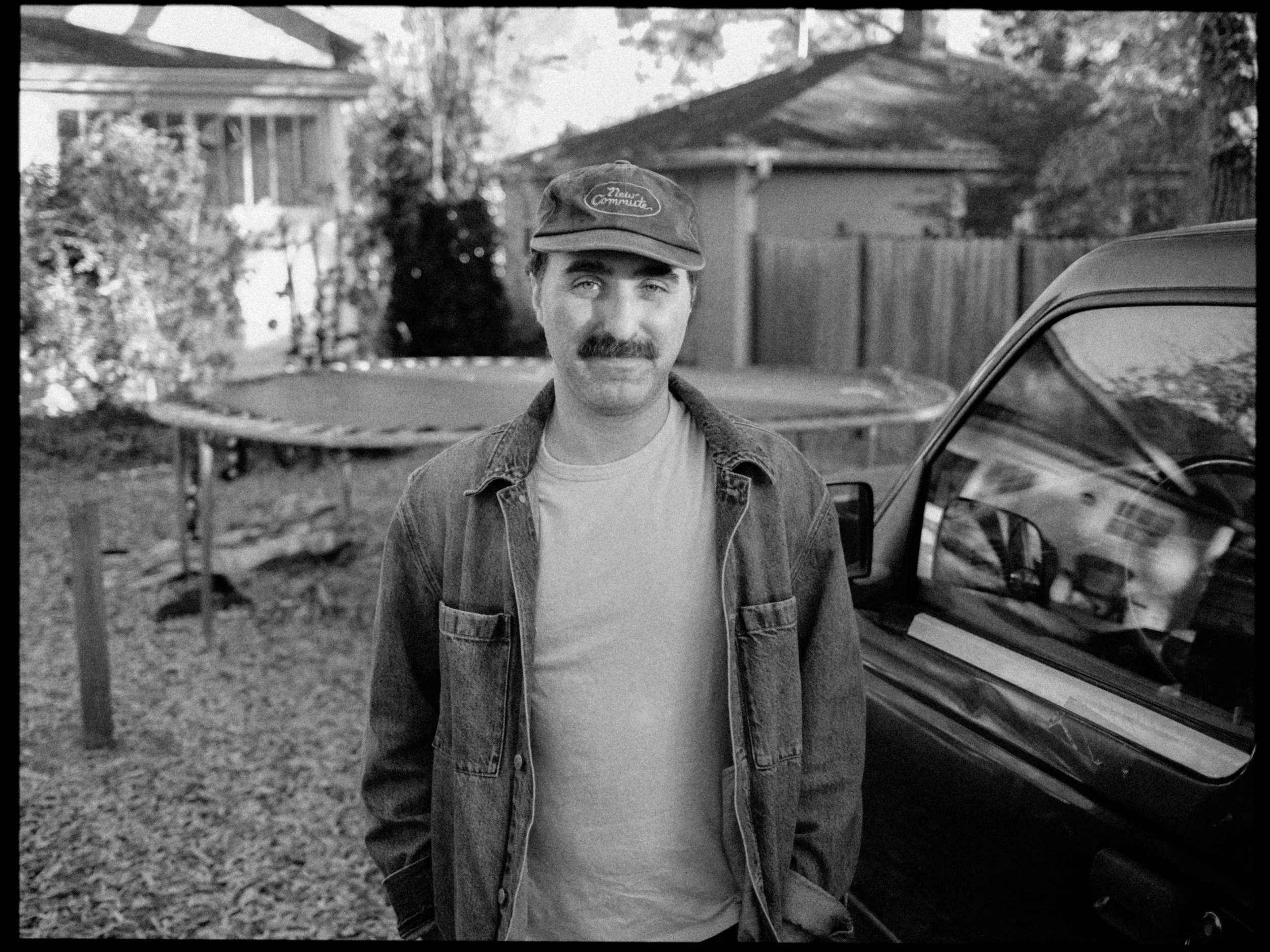
The characters inhabiting Lou Hazel’s songs — the downtrodden and derelict, the whimsical and resilient — are not figments of the Durham-based singer/songwriter’s imagination. They’re products of his rural, northern Appalachian upbringing.
The multi-dimensional artist born Chris Frisina hails from Olean, New York, a town of roughly 14,000 along the Allegheny River near the Pennsylvania line. “The rust belt of shit,” he calls it, with affection. “I grew up around blue-collar people who weren't artists and only knew about working and drinking. I love it back home. It's rough around the edges in a wonderful way that gives me a lot of inspiration. I have an endless amount of stories.”
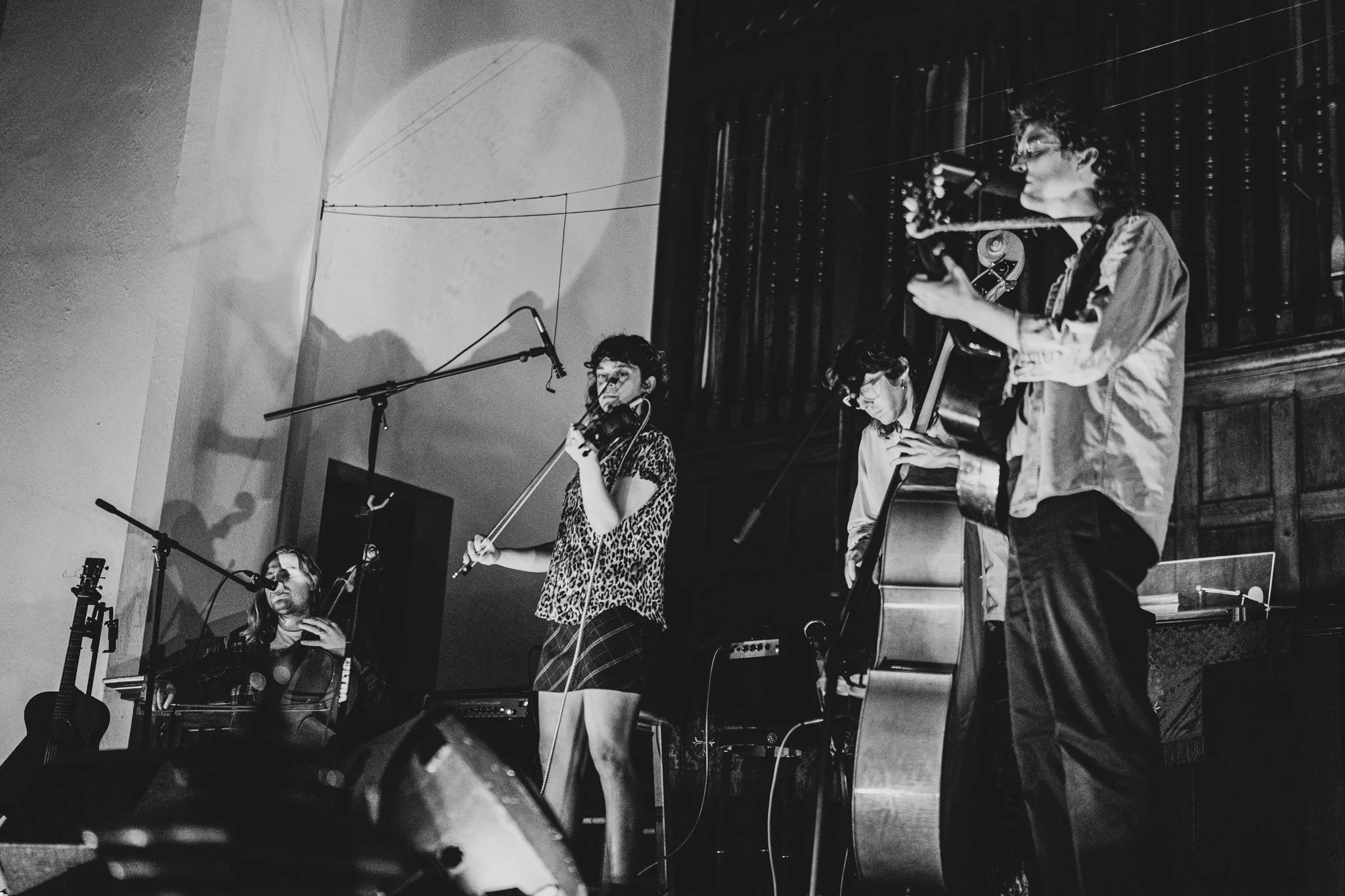
Many show up on his 2025 album Riot of the Red, which weaves stark, intentionally fractured portraits of said eccentric souls with meanderings that offer a glimpse into the author’s inner life. Frisina’s rolling, finger-picked folk guitar, weathered vocals, and signature cadence and meter — the comparisons to John Prine are fair — are supplemented by ethereal arrangements and production touches.
Asheville Stages spoke with Frisina en route to a one-off headlining show in Wilmington, N.C., sandwiched between a string of dates supporting John R. Miller that includes a Thursday, Nov. 12 stop at AyurPrana Listening Room. The conversation touched on his forthcoming album recorded with his friend and neighbor Mike “M.C.” Taylor of Hiss Golden Messenger, the 100 watercolors he painted and sold on a sliding scale to fund the project, and his enduring love of The Felice Brothers.
Jay Moye: Where do things stand with the new record?
Lou Hazel: We're mixing it right now with Scott Hirsch, so we're almost done. I'm shopping it around to see if someone wants to put it out.
JM: Was it nice to take your time and let the songs take shape organically over time, instead of being under the gun in a more traditional studio?
LH: Yeah, it was just a process of Mike [Taylor] and me hanging out. Each song is its own little world. We'd meet up to make demos by ourselves before finding a band to track over four days. There was a little pressure, I guess, when we brought our friends in to play, because I was trying to do it on a budget. After we finished tracking, friends would come over and add parts. It was a really chill experience — extremely small-scale when it comes to making a record.
JM: How would you compare the yet-to-be released songs to Riot of the Red? How has your writing evolved since then?
LH: It's hard to say. I'm my worst critic. Mike really loves them, and I really love them, but I'm overhearing them, you know? I think my writing is maturing a bit and simplifying. I’m not trying to fit a bunch of chords into a song or overcomplicate the lyrics. I can tend to mash a bunch of words into one song, and on this record there's some space that feels good. I was really trying to get a message across with fewer words.
JM: You painted a lot during the recording process, returning home after a session and quickly knocking out watercolors. Was that always your plan or did the idea hatch organically?
LH: It just kind of happened. I was still paying for the record and needed to figure out how to cover it. I thought, “What if I just make these paintings and do this Lou’s Mystery Oracle thing?” I'd come home and manically do these little five-by-seven [inch] drawings — really loose, abstract stuff. The idea was that [the supporter] didn’t get to pick the painting; I’d pick it for you, and it comes to you at random.
I put it out on my Substack and on Bandcamp and was super nervous at first. I sent out the emails while I was at Mike's working on a song and decided not to check my phone all day. Five hours went by, I opened Gmail, and there wasn't a single notification. Later that night I checked again — still no orders, so I thought nobody wanted them. Then, before bed, I opened Bandcamp and I'd sold about 50 of them. My Gmail just hadn't refreshed on my phone. I was so relieved. After I made an Instagram post, the rest went, too. I sold 100 paintings, which paid for that portion of the session work. It was super fun to have a vision and see it through.
JM: How does your songwriting and recording process influence your visual art, and vice versa?
LH: They’re totally separate. Drawing is a way to shut my brain off — a therapeutic relaxation thing, like abstract expressionism. It's another language, like journaling. You're just letting your hand go and not putting any pressure on yourself. The shapes take their own form, and sometimes you surprise yourself with a drawing that feels really good.
JM: Is your songwriting process more laborious and disciplined — more demanding cognitively?
LH: It is. To be honest, sometimes I feel like a poser, a phony. Because I’m so ADHD, so scattered. I'm inspired by so many different things, which makes it hard for me to write. I'm reading again for the first time in years. People think because you write songs you're intellectual or literary, but I don't know fucking shit! I’m an idiot. I’d be the worst person on your trivia team. Total space case.
I'm really trying to have a committed writing practice. I'll wake up and do writing exercises. I also practice mindfulness, with breathing exercises and trying to be present and aware of my surroundings every day. That’s really helpful with songwriting, because you’re witnessing all these stories and concocting something from that awareness.
But it's also important to write a bunch of bad songs and really do the work. I just need to show up more to the desk and the pen and write more. That's what I'm super excited about — trying to be more disciplined so I can write better songs and put out a bunch of records.
JM: I love your contribution to the just-released Felice Brothers tribute compilation, [Felice County Fair]. How did that come to be, and what's your connection with the band? You took on “Red Mustang,” one of the more complex and obscure choices on the album.
LH: I'm not really sure how I ended up on there. I'm one of the smallest artists on that compilation, and The Felice Brothers don't know who I am. I think The Lumineers are fans of my music. Brandy [Shultz, the compilation’s organizer] is the wife of the lead singer, Wes[ley], and she's a fan of my music. She reached out and asked me to do a song for the album.
The Felice Brothers were my favorite band when I was a kid. Ian Felice is the reason I wanted to write songs. He was and still is my favorite songwriter. When I was a senior in high school, my dad's friends went hunting up in the Catskills and ended up at a motorcycle bar where The Felice Brothers were playing. They brought back CDs, and my friends and I put them on and thought they were awesome.
My dad and all my friends would drink together when we were 19, because that's just how it is in our small town. My dad was a rowdy guy. He’d put us in the back of his truck and we'd drive two and a half hours to Buffalo. We'd get to the Mohawk [Place music venue] and go in with fake Michigan IDs we got from Toronto.
The Felice Brothers would have a cooler full of Yuengling on stage, throwing out cans to the crowd. My friends and I were catching them. I remember watching Ian play from the front row, and it was like seeing the way I saw my life being sung back to me by someone. It was so profound. I thought, “This is how I want to write songs.” To me it was better than John Prine or Bob Dylan or anybody I was listening to.
I'm ecstatic to be on the tribute. I chose "Red Mustang" because I wanted to do a really deep cut — something weird.
JM: You started presenting your music as Lou Hazel circa 2020. What does that moniker let you do, creatively, that your own name wouldn't?
LH: It came from when I was living in this tiny house in Durham. My neighbor's dog's name is Emmylou. She’d come knock on my door every morning with her paw, and I'd give her a treat. It became a routine and was the cutest thing ever. She had hazel eyes. One day I was having coffee, threw her a treat, and called her Lou Hazel. I thought, “Oh, that's my band name.” At that time, I was touring a lot with Hiss as his guitar tech and had been trying to think of a different name.
It's given me a lot of freedom. I love making art and making my own merch, and I can put Lou Hazel on something and feel really good about it. A lot of my friends, as well as other bands and people on the road, have started calling me Lou. I've accepted it.
JM: Is it almost easier to write about home now that you're removed from it?
LH: I think so. But it's hard not to feel conflicted. There's a photographer I really like, Stacy Kranitz, who photographs rural Appalachia — really raw, amazing photographs. But the people in those photographs will never see them because they're in big galleries and books and written up in The New York Times. There's a lot of good in documenting and showing people a world they don't know anything about. But there's also something strange when you come from that and know how much people struggle and how much poverty there is. It can feel like you're exploiting the place where you grew up. It's all those things at once. There are so many truths. Sometimes I wonder if I'm doing the same thing with my songs.
It's very raw imagery, these characters we dive into and become part of their lives. It's the whole picture, you know? It's weird to think about all that and how to write a song that still feels really genuine when you're also feeling like you're betraying people.
I don't live where I grew up any more. I like art and yoga, and I don't work with my hands. I'm a pussy with this redneck residue. I lived it, but I left and I'm different now. But I can go home and hang and relate to the people I grew up with. I can talk shit with the best of them and relate to the working class and the people I grew up with. My parents' first house was a trailer. My dad was a tree trimmer and my mom was a used car salesman.
I do music full time because I don't have another option, and in my own way I'm still blue-collar. I'm out on the road busting my ass playing shows. I’m 36 years old with no savings account or safety net. I live in a shotgun apartment with my girlfriend. Half the time, my washer-dryer is broken. And I get my teeth pulled because I can’t afford root canals. In my own way, I'm gnarly. But I've also become bougie in my own ways. I have to drink the right coffee in the morning, and I don't like to sleep on couches any more. I'm into all these things [that] people where I grew up don't understand.
I've been writing in open tunings — kind of like Nick Drake — reading a lot of haiku and doing minimalist contemporary stuff. I've wanted to make a noise record. Then I find myself opening for John R. Miller, playing the songs I recorded straight to tape for Carolina (Out of My Mind) because a lot of his fans are big country folks. I can still go there and it feels really good because it’s still a genuine part of me.
It's funny to have all these different layers you can peel back. A week from now, I'll be listening to a jazz record and want to do some abstract work. Maybe I'll listen to Sun Ra or light some incense and go on a meditation retreat and leave everything behind. It's chaotic, but I'm trying to embrace all of it. We all have these different spheres we can move in and out of, but it’s hard for me to figure out what direction to go.
IF YOU GO
Who: John R. Miller with Lou Hazel
When: Thursday, Nov. 12, 7 p.m.
Where: AyurPrana Listening Room, 312 Haywood Rd., ayurpranalisteningroom.com
Tickets: $23.70
(Photo by Lou Hazel)