
Interview: Andrew Bernstein + Owen Gardner (Horse Lords)
Horse Lords are a band who make music that sounds as though the members are working out a complex math problem in real time while also possessing the driving, centrifugal rhythmic force and sweeping grandeur to be the rightful score for the next Dune movie.
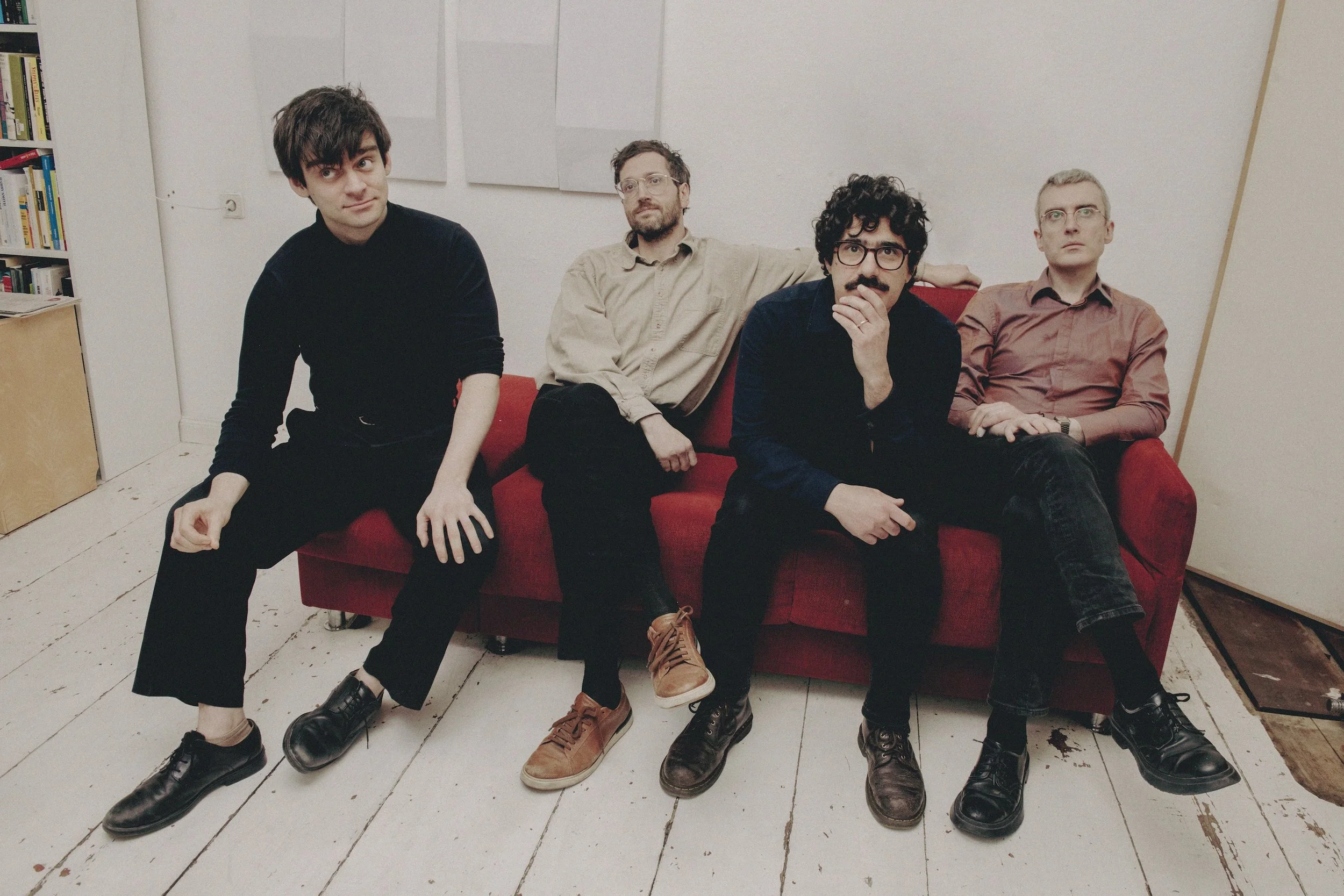
2026’s Demand to Be Taken to Heaven Alive!, the Baltimore-formed, Germany-based band’s 10th album since 2012, once again demonstrates how Andrew Bernstein (saxophone/percussion/computer), Max Eilbacher (bass/computer), Owen Gardner (guitar/percussion), and Sam Haberman (drums) advance their visionary compositional ideas and flawless execution.
In addition to experimentations in just intonation and intricate polyrhythms, Horse Lords added new elements in the creation of the new album, including incorporating acoustic instrumentation and, most notably, shape-note singing. Drawing from the New England and Southern tradition known as Sacred Harp singing, Horse Lords used the 19th century hymn “Eureka 378-B” as the thematic foundation and through-line for all of the music on Demand to Be Taken to Heaven Alive! If all of this seems way too heady, simply listen to the new album and be prepared to be shaken, spun, and transported like the best in sacred music and rock and roll alike.
In advance of Horse Lords’ appearance at AyurPrana Listening Room on Monday, Oct. 12, Asheville Stages interviewed Bernstein and Gardner about the band’s compositional approach, the unique way in which the new album was recorded, the pervading question of how to present the new music live — and toothpicks.
Scott Bunn: Can you describe the process of how the band composes its music? Does one member bring a riff or a part and everyone works together to build out the song? Or does one member compose parts for the rest to play?
Andrew Bernstein: It varies by song, but it’s often that one member will come up with an idea that the others elaborate on. Sometimes the idea includes a part for others to play and the whole thing might get twisted as we work it out. Earlier in the life of the band, this would mostly happen live in the course of practice or performance, but more recently we’ll share demos with each other online and go back and forth that way — which changes the dynamic a bit, not being able to have a real-time conversation about the music. Many conversations are had about the demos and what might come next or get added to a part. Usually everyone makes a contribution before we call something “done.”
SB: Owen, I understand that you have been participating in Sacred Harp singing for a while. How long has it been?
Owen Gardner: I haven't been doing it continuously for this long, but I started doing it when I was 13 years old.
SB: "Eureka 378-B" is the opening track of the album and then it is laced in throughout many of the subsequent tracks. Was that specific song the starting place for composition or was it selected from other Sacred Harp songs because it would work for pieces you had already composed?
OG: We'd been talking about incorporating Sacred Harp music for a while. There was no clear way that that would happen. And then my friend Nina [Guo], who's one of the singers on the record, had proposed working together, and we thought that sounded interesting. One stumbling block earlier with incorporating this [song into the band’s music] was the lyrics. The lyrics are generally Christian lyrics about death — which is fine, but it'd be a little off-message for what we do. But [the lyrics of "Eureka 378-B"] stuck out as, “OK, this actually fits our theme.” And, of course, musically, it was likely to gel.
SB: The song fits a theme for the record or is it a theme for the band?
OG: I would say a theme that sort of runs throughout our career, but also the themes for the record kind of emerged out of the material. It's very rare that we start with an idea. It's never really happened before because, usually, we just have this pile of material and we're like, “OK, what's this about?” Or build a narrative out of [the music] post hoc rather than beginning with a concept. That's always been the case, and that was the case with this [album], too.
So, this particular song, it came at the same time as a lot of other elements, and it informed other little bits. We wanted the record to have this recursive feeling, where the same material is sprinkled throughout and the compositional scale feels the same from the beginning to the end of the record, rather than individual songs. They're all modules that are part of a larger thing. The song came first; 100-plus years before other songs. So, in that way, I guess it preceded the rest, but it was also developed in tandem. We found ways to fit it in, but it wasn't the starting point, exactly.
SB: There are two songs on the record titled “First Galactic Utopia” and “Second Galactic Utopia.” How do the two connect? Are they one composition that was split apart or did “First Galactic Utopia” generate the idea for “Second Galactic Utopia”?
AB: They have very little to do with each other besides maybe the vibe. Both are slower and bass-driven, but they have nothing to do with each other compositionally. Titles are usually the final part of finishing a piece — only when we need to tell the designer what to put on the record sleeve.
But we did like the idea of having a “First” and “Second” Galactic Utopia. We put a lot of emphasis on utopian ideas in our music, but also try to complicate the idea of utopia. The existence of a “Second Galactic Utopia” kind of implies that the “First Galactic Utopia” didn’t work out, that maybe there is never a final stage Utopia that we’ll just arrive at, and that maybe it’s an idea you are always working towards.
SB: How much editing and post-recording manipulation did you do for this record as opposed to previous albums? Samples are incorporated into the songs throughout and some of the music seemed to be chopped up, too.
OG: Everything was chopped up. This is by far the most post-production of any record — it's all assembled. We were never in the same room together. Sam recorded in Baltimore. We were in touch with him, but we obviously weren't there. And we all recorded in Berlin, but still separately. Nothing happened together. Everything was overdubbed. A lot of ideas were still fairly half-baked at the recording stage. They were assembled in post. Even some of the composition was happening in post.
Sam had to record his parts before the rest of us and, in some cases, the pieces were not done or barely even started. He would propose variations like, “Maybe this is the B part.” Or if there were sections where he's just playing something, he's like, “This has no particular place, but maybe this can be something.” So those got made into sensible shapes, and then we built the rest of the parts around that. It varied piece by piece. Some pieces were basically through-composed and, [for] others, different elements were smashed together in post.
SB: Was that harder than previous records that you've done?
OG: [Laughs] I would prefer never to do this this way again. It was educational, and I'm happy with the result. And it had to be this way. But, no, for my part, I vastly prefer actually playing together. It's easier and it's more satisfying and takes a lot less time to put together. We'll always have a sort of blended approach, but, overall, this was imbalanced in favor of sort of studio magic.
SB: Andrew, what’s the decision-making process behind you playing saxophone on a particular track? Is it instinctual on your part or does the band agree on it beforehand?
AB: Again, it varies by song, but I guess it is somewhat instinctual. Some pieces begin with a saxophone idea, or an interlocking melodic idea that would require the saxophone to play a part. Other times I’ll play around with different ideas on the saxophone or percussion, and one will seem more compelling than the other.
I think there is only one recording where I am playing saxophone and percussion — on the second half of “Zero Degree Machine” from Comradely Objects. I play only percussion on the first half, but we decided it would sound good to have the sax double the guitar on the second half, maybe in part because it leads into a sax part in the outro. When we play it live, I’ll switch from percussion to saxophone.
SB: Last year, RVNG released FRKWYS Vol. 18: Extended Field, a collaboration between Horse Lords and the minimalist composer Arnold Dreyblatt. How did you meet him and decide to record together? Can you trace any association between that project and Demand to Be Taken to Heaven Alive!?
AB: Arnold wrote to us on Facebook in 2017 just to say “hello” and that he liked our music. We were fans of his music, and had even talked amongst ourselves — maybe inspired by his collaboration with North Carolina’s own Megafaun, Appalachian Excitation — about how it would be cool to work with him one day if we got a chance to meet. He’s been based in Berlin since the 1980s, and, after we moved to Germany in 2021, we finally met and asked him if he wanted to collaborate in some way, not knowing what it would look like.
The music came together over the course of a couple of years as we learned each other’s working methods and came to know each other better. We generated a lot of ideas for the project, many of which didn’t make the cut, and a couple of those ideas were reworked into pieces on Demand to Be Taken to Heaven Alive!
SB: Was it difficult to arrange the songs from the new album for live performance?
OG: It remains difficult. We haven't put everything together. I think some pieces we just won't bother with. But we're playing three of them now and we’re nearly at being able to play a fourth.
“Brain of the Firm” is pretty easy. We're doing it without the singers, so Andrew and I just play the opening vocal part. It's not so terribly different from how it is on the record. Although, there are multiple guitars on the record and I only have one guitar and I'm one person, so there definitely are still accommodations that had to be made.
“First Galactic Utopia” took some rethinking for the guitar. We do “After the Last Sky,” also a relatively straightforward song. The acoustic guitar, of course, is gone and there's a different guitar intro now, but it's still not so different from how it is on the record. That was a through-composed song, so that was not so challenging,
SB: So, the goal is still to determine arrangements for other songs for the new album?
OG: Yeah, I think a few more, at least. I think some will likely never be played live. “A City Yet to Come” — maybe on a very special occasion we will play that, but that's a lot of work. The title track — a live version is forthcoming, but we haven't quite gotten there yet. If we did it live, it would just be like playing a recording that doesn't sound so satisfying, so we're figuring out a different way to do that.
SB: Does the band ever improvise, either in public or private?
AB: A lot of the music is flexible in a way that requires some improvisation, as far as how long a certain section lasts. So, everyone might be in a holding pattern waiting for a certain cue and have to jump out of what they are doing into the next section. Mostly the music is pretty through-composed, with the exception of some of my parts on the saxophone, where in certain pieces I have quite a bit of freedom to do whatever I want, and I often do. For a long time, we’ve also featured solo interludes in between pieces when we play live, and these will often incorporate more improvisation.
Outside of Horse Lords, I improvise quite a bit in my solo practice and in group settings, and Owen and I were involved in a free improvisation festival in Baltimore for many years, the High Zero Festival. My relationship to improvisation has changed over the years and it’s not as central to what I do anymore, but still important.
SB: Now that you have added singing and words into Horse Lords as well as acoustic instrumentation, what does the next evolution of the band look like?
OG: We're not thinking that far ahead. We don't really plan in this way. It's always iterative. We're continuing tinkering with the same sort of set of ingredients and trying to expand this set of ingredients we've already been working with.
We've been talking to a friend who plays in a chamber orchestra — so, theoretically, something like that could happen. I think we're always trying to find new ways to sort of incorporate electronics. But there's no plan. There's no, like, “Because we've done this, now we can do this.”
SB: This might be a little silly, but I saw you guys at Big Ears [Festival] a few years ago: did you have a toothpick in your mouth when you were playing?
OG: Yes, it’s something that I always do. Maybe not coincidentally, it started after I quit smoking. I don't know how to explain it, but I just have to have something anchored in my mouth. I don't know if you've ever seen this, but many musicians, not just guitar players, are kind of doing all sorts of weird stuff with their face the whole time [when they perform]. I was chewing on my lip a lot, and I didn't want to do that, so it was an easy fix to satisfy my oral fixation.
Strangely, I was in Mauritania early this year, studying music there. I went to my first lesson and I put in a toothpick, and the teacher was like, "How did you know to do that?” And I was like, "What do you mean?” He was like, "That's what students do.” If you're a student in Mauritania, you're expected to have a stick in your mouth.
SB: Expected to!
OG: Yeah, it's just part of the thing, and it is sort of the same idea. It's a way to stabilize your face.
IF YOU GO
Who: Horse Lords
When: Monday, Oct. 12, 7 p.m.
Where: AyurPrana Listening Room, 312 Haywood Rd., ayurpranalisteningroom.com
Tickets: $25.90
(Photo by Kasia Zacharko)