

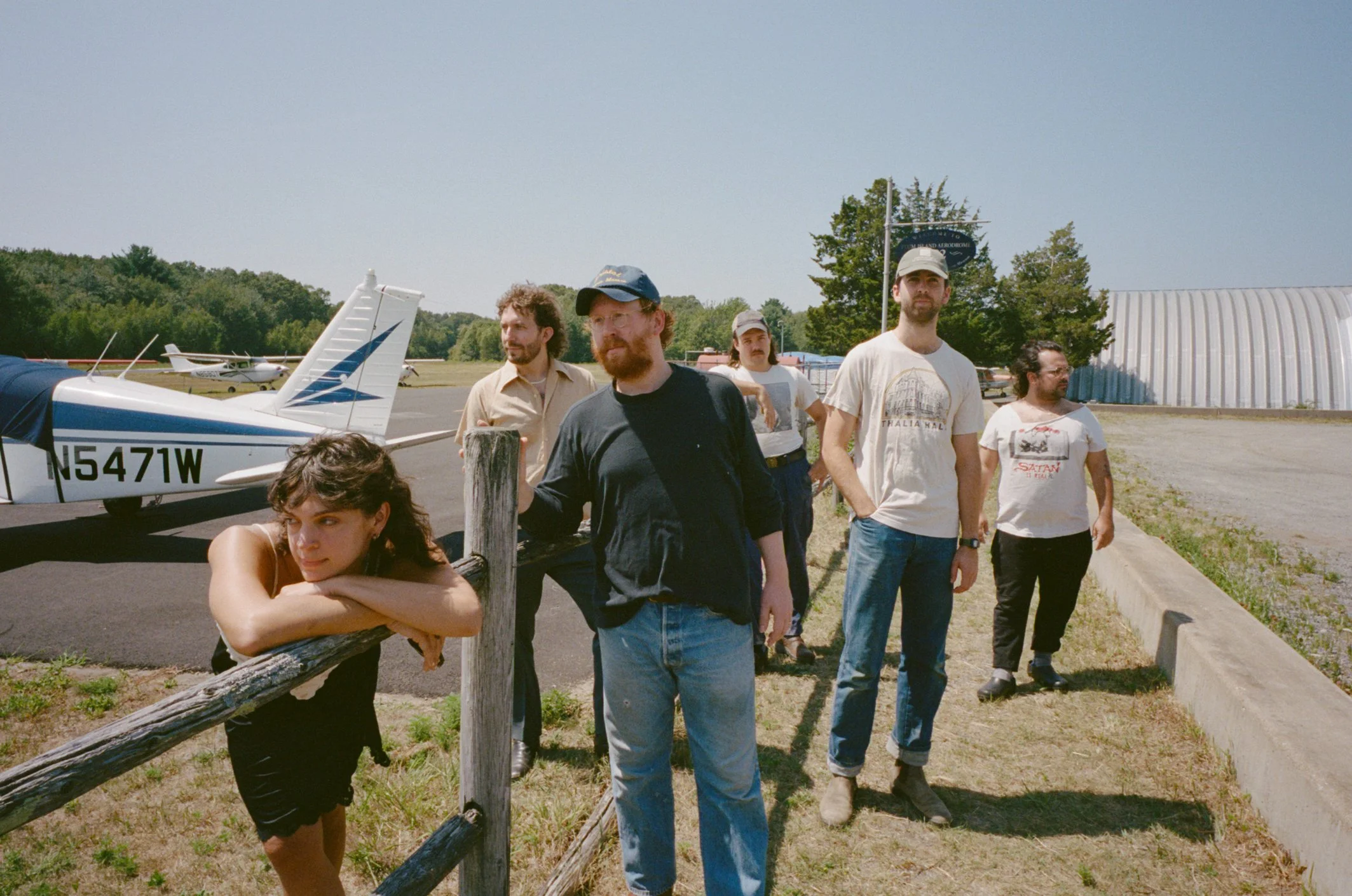
Interview: Aaron Dowdy (Fust)
Aaron Dowdy doesn't write about the South so much as he writes from inside it — capturing its cracks, overlooked nuances, and unique capacity to hold contradictions through portraits of messy people navigating loaded landscapes with grace and grit.
“I've never explicitly tried to say something about the South,” says the songwriter and driving force behind the Durham-based band Fust. “When you start with people and lived experiences — real relationships that are complicated on their own terms — then put them in a place that’s also complicated, those are the layerings I'm interested in. They keep you from pedantic, self-aggrandizing, or ridiculing posturing.”
Fust’s third album, Big Ugly, was recorded at Asheville's Drop of Sun Studios with Dowdy’s UNC Asheville classmate Alex Farrar and released in March 2025 on Dear Life Records, the label that launched MJ Lenderman and Florry and has become a home for some of contemporary Americana’s most literate, lyric-driven voices.
At its core, Dowdy's creative process is deliberate and deeply private. His intimate story cycles start out as solo demos, with him tracking all parts on his laptop and building a container for each song before anyone hears it. Only when a tune passes this initial litmus test does he bring it to his trusted bandmates: drummer Avery Sullivan, pianist Frank Meadows, guitarist John Wallace, multi-instrumentalist Justin Morris, fiddle player Libby Rodenbough, and bassist Oliver Child-Lanning.
That instinct shapes how Dowdy handles the South as subject matter. Instead of delivering tidy verdicts or platitudes, he lets the underlying friction carry the bulk of the narrative burden. A PhD candidate at Duke University who divides his days between writing his literature dissertation and making music, he brings a scholarly respect for complexity to his craft without letting it tip into obscurity. He leaves room in his songs — for characters to resist easy readings and for listeners to fill in gaps themselves.
Asheville Stages spoke with Dowdy from Austin midway through Fust’s national tour with Merce Lemon, which kicks off a three-night home state finale on Wednesday, April 15 at the Grey Eagle.
Jay Moye: When and where did the concept of Fust start?
Aaron Dowdy: I wrote songs under different project names when I was in high school [in Bristol, Va.] and college in Asheville. When I moved to New York City, I wasn't really doing songwriting. I was soul-searching, trying to figure out what I was going to do with my life. And it hit me really hard that I wanted to write songs again. I was in a really cramped, small apartment and couldn't spread out with a band, so I recorded a bunch of songs on my laptop starting in 2018 and needed a name for it. I thought it was just going to be a temporary thing before moving on to something else. But I liked the word a lot. We got a little band together and played maybe one show a year during my time in New York.
I was missing the South. For me, song is attached to home. Wanting to write again was a kind of calling from home. I moved to Durham in 2020 and that’s where the band came together. After our first album, Genevieve [2023], we started playing shows and grew from there.
JM: What did you do for work in New York?
AD: A lot of different things. I worked at the public library. I thought maybe New York would have the energy or the answers. And it kind of did. I met a lot of great people, but my favorite moments were just sitting on back porches and realizing, “This is what I did back home.”
JM: Where sitting on porches is a lot cheaper.
AD: Exactly. I really think of Fust as a North Carolina project. We all live in Durham, which feels like home. It’s a really warm and welcoming community, and I'm very happy to be a part of it. I can’t really name why, but North Carolina keeps people because it’s just a great place to live. And the East Coast is such a good place for touring bands to be based.
JM: It is. There seems to be something in the water here in North Carolina.
AD: It’s true. And we all need to drink more of it.
JM: Fust and Sluice, fronted by Justin Morris, share band members. What does the creative cross-pollination that comes with being part of such a rich creative community do for your songwriting that working in isolation can't?
AD: That's a great question. It makes the music more social, which took me a long time to figure out. Music is very personal. I’ve always loved songwriting and home recording because it’s very hermetic, experimental, and really for no one. If I finished a song, I’d send it to my friends and they would be the audience. Whereas a band is a commitment to giving way to a more social experience. And it becomes much more interesting when you have a community of people who are also writing incredible music. Songs speak to each other, and the music seems to respond and inspire everyone. It’s this snowball effect where we're all keeping each other going just by making music. Music is this pretty incredible glue.
JM: Does isolation still shape your writing now that the band has fully coalesced?
AD: Yeah, I feel like the act of writing a song will always be a very internal, quiet pursuit. I have my own recording approach: I'll demo at home, do all the parts, and make sure the song I'm chasing has a container that feels good to me. That's a very private experience for me. If a song works privately, I’ll bring it out to work on together as a band. On this tour we've been doing, I'm working on the next record and playing new songs live. I feel them leaving my computer, developing, and becoming part of the world on tour.
JM: Is it gratifying, as a songwriter, to start something and see it flourish after surrendering an initial draft to the band?
AD: Definitely. It’s also great to have people respond to the new songs, emailing us after the show asking where they can find them on streaming. A live show is a workshop, not just a performance of what already is. It’s a place for us to test things out and keep growing. So it feels really gratifying to remove myself from that private sphere and have other people hear new things that feel fresh and like an experiment, like we're still searching. People are smart; they pick up on that stuff.
JM: Does the close-knit nature of your band breed trust and freedom to experiment?
AD: Absolutely. These are all my best friends, not hired guns. I luckily have my five best buddies, and we all respect each other and each other’s songs. We’re all here for the sake of the song, as they say.
JM: Where are you in your PhD program?
AD: I'm what they call ABD: all but dissertation. I'm just writing now. I'm pretty far along and hopefully will finish within the next year or so. It's a funny mental space to be in, where I'm switching back and forth every day. I'll wake up in the early morning and work on writing, then get to the library where it’s really silent. That's a private thing I'm really drawn to. Then come home and work on music.
JM: Do you work on your dissertation while touring?
AD: I do. We'll get to a venue around four to set up, then I’ll write a bit during the downtime before the show. And I wake up at 7 a.m. and go down to the hotel lobby or the kitchen if we’re staying at somebody's house and work on my dissertation until the rest of the band's ready to go.
JM: It sounds like you’re tapping into different parts of your brain when you switch gears between music and academia. Do the worlds of text and theory, and the more instinctive, gut-level approach to songwriting bleed together, or are they entirely separate?
AD: They have to bleed together on some level because it's literally me doing it. A good piece of writing, to me, keeps giving meaning beyond first listen. Fust — in terms of my lyrics, the musical references we're making, and the themes we’re blending — feels maybe the closest I've ever been to explaining how the two are similar. Just a love of levels, without explaining everything away and trying to respect complexity. I personally really like things that seem like a contradiction. I like for there to be different tracks of thought and disposition that come into conflict. Sometimes one will take over. It's a sweet little battle that's very productive for me.
JM: You recorded both of your studio albums, Genevieve [2023] and Big Ugly, at Drop of Sun. What about that environment lends itself to great records?
AD: On a fundamental level, it's the people. Adam McDaniel and Alex Farrar, who I’ve known since our days at UNCA, have a great team. It’s a sweet, supportive, and intuitive group and a comfortable environment. You never feel like you're in somebody else's space. The studio is entirely set up to be yours in that moment. Working at Drop of Sun is like making a record with your old friends who happen to be the best at what they do. It’s more than you could ask for.
JM: I'm hearing a theme. Your creativity and art seem to be grounded in friendship.
AD: Yeah. I've always kept really close friends. They're the ones I initially feel safe to make music for and with. I’ve never really had a big vision for music. I’ve just surrounded myself with friends with good hearts and who care about what I’m doing. Music can be competitive — a pit of snakes kind of thing — if you're not careful. But if you keep good friends around, everything flows so much easier.
JM: I’d say that's true for just about anything in life.
AD: I agree with that. I think it's a tried-and-true method of feeling okay in this world.
JM: You described your feelings on the South as complicated, with tension around both commitment and resistance to a place. How do you keep that friction alive in your writing without it tipping into nostalgia or cynicism?
AD: I spend most of my days in the South, so I'm not looking too far from home for my experience or what I’m writing about. A lot of people write about their complicated families, friends, or relationships. I like pulling that out. I like character studies. I tend to want to bring out place in a song — to literally give it room to feel alive and lived in. I want any image I bring to a lyric to feel like it could very easily exist. I think about what the South means, the places it creates, and the tensions inherited in those places.
JM: Do you leave that up to the listener to decode?
AD: I like it when it’s the duty of the reader, listener, or viewer to fill in a gap in the story. That's what keeps them active and dreaming. I trust listeners. I'm not somebody who thinks “they’re not gonna get it.” I truly believe that people love to think. So, I make things a little bit complicated — but never too complicated — and leave a little room for the listener to make decisions.
IF YOU GO
Who: Fust & Merce Lemon w/ Thomas Dollbaum
When: Wednesday, April 15, 8 p.m.
Where: The Grey Eagle Music Hall, 185 Clingman Ave., thegreyeagle.com
Tickets: $22.14
(Photo by Pond Creative)