
Spring Awakening at Asheville Musical Theatre
An enthusiastic group of young performers calling themselves Asheville Musical Theatre (AVLMT) arrived on Asheville's theatre scene June 24-28 with a passionate production of Spring Awakening, the 2006 Tony Award-winning rock musical based on German playwright Frank Wedekind's controversial 1891 play about repressed adolescent sexuality.
With a few smaller offerings already under its belt in the Wortham Center for the Arts' Tina McGuire Theatre, the company made its June mainstage debut in the Diana Wortham Theatre, heralding the company's ambitious plans to make its mark in Asheville.
Wedekind's Spring Awakening shocked audiences with its frank portrayal of teenage sexual activity, masturbation, out-of-wedlock pregnancy, abortion, suicide, and homosexuality. It was outright banned or heavily censored for decades and was rarely staged professionally.
Then playwright and lyricist Steven Sater and composer Duncan Sheik broke new ground by having the play's characters step out of their German setting, pull microphones out of their 19th-century pockets, and launch into pulsating rock concert performances.
Choosing Spring Awakening to kick off its next phase of growth, AVLMT has certainly kept its promise to offer “bold, accessible musical theatre that engages diverse artists and audiences, challenges perspectives, and celebrates stories from every walk of life.”
The musical follows a group of boys and girls in a small provincial German town as they grapple with the pressures of school, family, and their emerging sexual awareness.
At the center of the story are the intelligent, questioning Melchior, played by an earnest Caleb Hector; the academically overwhelmed and emotionally fragile Moritz, portrayed with nervous intensity by Maximilian Koger; and the innocent Wendla, a sweetly vulnerable Emma-Leigh Brookshire.
Wendla's desperate curiosity about love and sex is met only with adult evasion and misinformation. Her mother still tells this 14-year-old that the stork brings babies and, when Wendla insists on knowing more, explains only that a woman conceives when she is married and her husband loves her.
Their intersecting stories build inexorably toward tragedy as Moritz learns he has failed his exams, Wendla discovers she is pregnant without understanding how it happened, and Melchior is expelled and sent to a reformatory after school authorities discover an essay he has written explaining the mechanics of sex.
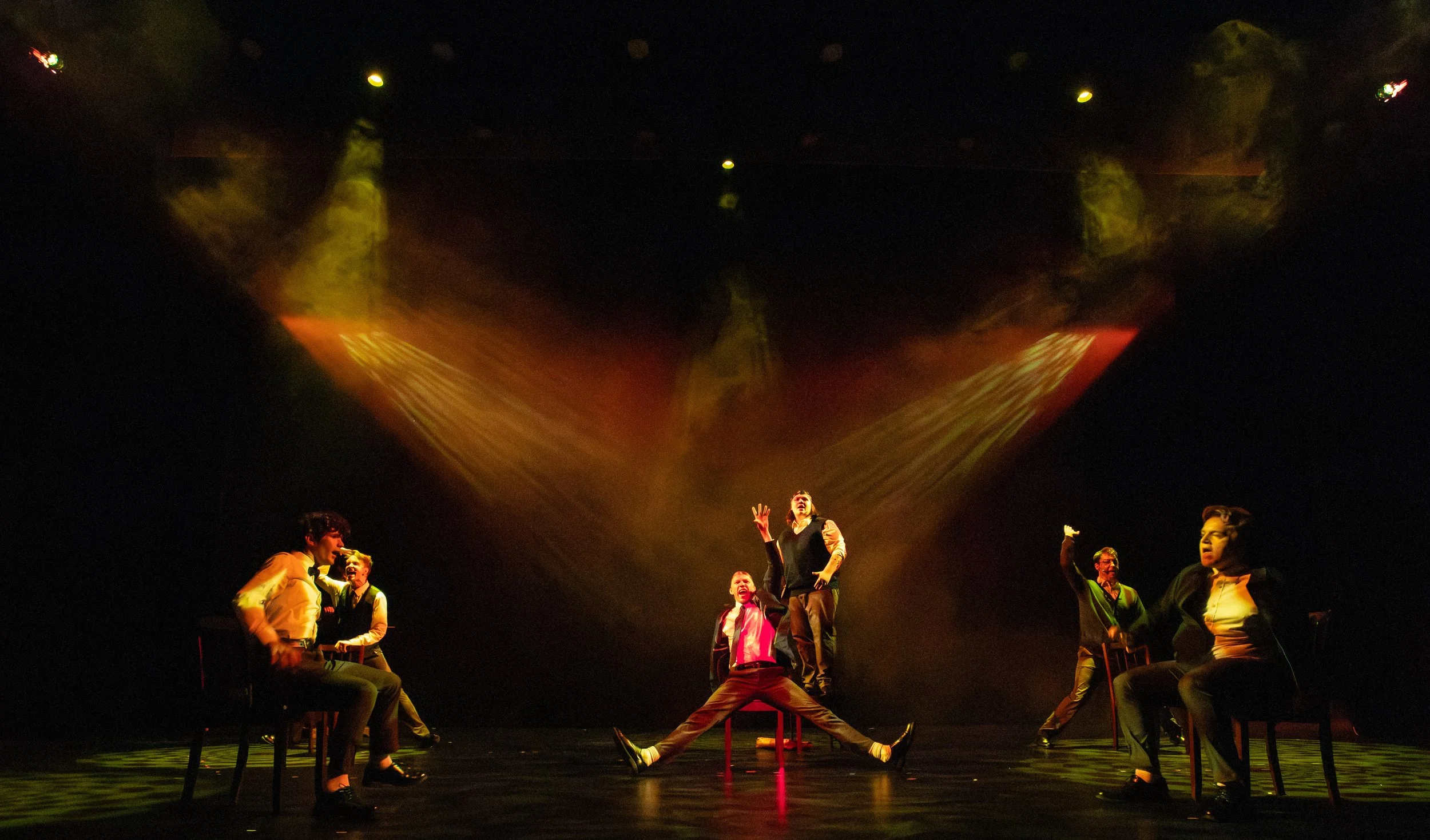
Director J. Ethan Henry, one of AVLMT’s founders, has assembled a gifted cast of actor/singers who attack the demanding material with great emotional sincerity and vocal skill. He fluidly maneuvers his performers around a bare, black-curtained stage as they place chairs and an occasional furniture piece to suggest locale changes. Over the many quick scenes, the effect is nicely cinematic.
Henry, who also designed the show's costumes, chooses not to adhere to period authenticity as the Broadway and off-Broadway original did, nor does he have his singers pull out microphones for the rock numbers. As a result, the contrast between 19th-century Germany and 21st-century America isn’t as sharp as the show's creators intended.
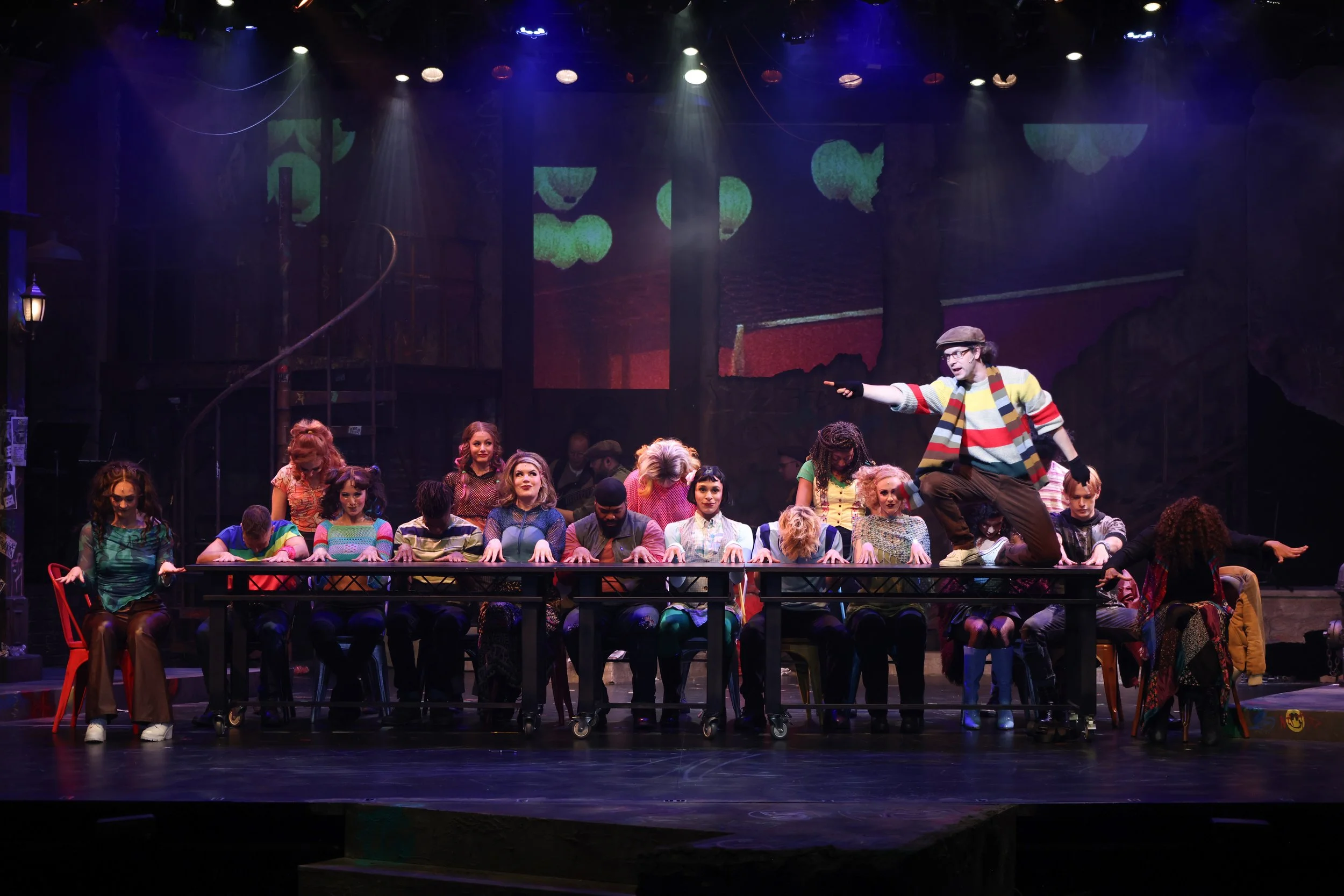
Lighting designer Destini Fleming's highly saturated lighting — lots of reds, blues, and greens — casts a moody intensity over all the scenes. It especially gives the big musical numbers a high-powered rock-concert energy.
I do wonder, however, if Fleming was hampered by an insufficiency of lighting instruments. In full-stage moments, backing performers are sometimes better lit than featured players and I often had to scan the stage to find the actor who was speaking or singing.
Along with Henry’s dynamic staging, choreographer Zoe Zelonky combines simple steps and movement patterns with some feats of acrobatic virtuosity that had the audience cheering.
Among the many strong performances, Hector, Koger, and Brookshire stand out, as do Reed Atherton’s Hanschen and Alex Poteat’s Ernst, two boys acknowledging they are attracted to each other. In a touching, almost light-hearted scene, Ernst says, “I love you, Hanschen, as I've never loved anyone." "And so you should," replies Hanschen. Their refreshing exchange, a moment of emotional honesty amid all the confusion and repression surrounding the other characters, got one of the evening’s best laughs.
All of the adult characters — school authorities, parents, a doctor, a minister, a piano teacher, and numerous others — are played by Fancy Marie and Richie Barrella. This decision may have been Wedekind’s way of lumping together all these stifling adult presences. And the names he gives some of them — Sonnenstich (Sunstroke), Knochenbruch (Bonebreaker), Brausepulver (Fizzy Powder), Kahlbauch (Bald-Belly), and Grossebustenhalter (Big Brassiere) — clearly show the playwright’s satirical intent.
But Marie and Barrella give each one a subtle variation in posture, costuming, or vocal quality that, had you not read the cast list carefully, might make you think you were seeing different actors. They are a masterclass in actor metamorphosis.
Like all musicals, Spring Awakening depends on its lyrics and dramatic scenes to carry the narrative. And like many contemporary rock musicals, AVLMT’s production is heavily amplified. Unfortunately, the amplification was a problem during the June 24 performance, frequently rendering dialogue and lyrics into a mush of sound. It may have been a matter of balance between recorded orchestra and live actors, or it might have been muddy diction. Either way, it’s something for AVLMT to work on as it seeks professional standards for itself.
Despite a few technical flaws, AVLMT has embarked on an audacious path to become an important force in the region's cultural life. On the evidence of Spring Awakening, it is definitely a company to keep your eye on.
(Photo by Cheyenne Dancy)