
No Child . . . at NC Stage Co.
Think of a kaleidoscope. You’re looking at jumbled shards in mirrored compartments against a bright light. The kaleidoscope turns, and the physics of reflection creates intricate, repeating patterns.
That’s the effect of watching the terrific actor Veanna Black in No Child . . . , Nilaja Sun's one-woman autobiographical fantasia which opened April 29 at NC Stage Co. Black portrays the tumultuous few months that Sun, a professional actor, spent as a teaching artist at a decaying high school in the Bronx. She also creates striking portraits of a dozen-plus other characters: rowdy students, members of their families, and school staff, ranging from janitor to principal.
On stage continuously for a breathtaking 65 minutes, Black makes split-second transformations. She adjusts her posture, changes her voice and accent, makes a quick revealing gesture, shifts direction. With each turn, a new character comes into focus. It’s bravura actor magic.
Like Black’s quick-change artistry, the plot of No Child . . . unfolds as quick-cut cinematic vignettes. Ms. Sun, the dramatist’s onstage persona, arrives in late fall at the fictional Malcolm X High School and presents a theater project to a skeptical class of African American and Latino students. They will rehearse and perform English playwright Timberlake Wertenbaker’s 20th century play Our Country’s Good. It’s about a group of convicts in 18th century Australia performing George Farquhar’s The Recruiting Officer, an unlikely choice for disadvantaged New York high schoolers.
The montage moves through casting and rehearsals. Roles are assigned and abandoned, practices dissolve into chaos, students are suspended and return, the brother of one student dies in gang violence. It culminates in a hard-won opening night.
You may hear echoes of other stories of high school underdogs who come triumphantly from behind. But Sun’s voice is so rooted in reality we’re happy to go along.
And Black’s portrait gallery is so vivid, we perceive each character almost as a different actor. There’s Ms. Tam, the regular classroom teacher who introduces Ms. Sun. She’s polite and pragmatic, grateful for help but realistic about what her students will and won’t do. There’s Mrs. Projensky, a flustered substitute teacher, a comic embodiment of the school’s institutional breakdown.
Three characters in particular stand out. Janitor Baron begins and ends No Child . . . like the Stage Manager in Our Town. He’s a folksy narrator who stands both inside and outside the story. At first, he seems almost incidental, a man with a broom, moving through the edges of the scene. But he watches and listens. He understands the wider social context. He gives his wry perspective on exactly where Malcolm X High School stands in the world: “Taking the 6 train, in 18 minutes you can go from 59th Street, one of the richest congressional districts in the nation, all the way up to Brook Avenue in the Bronx, where Malcolm X High is — the poorest congressional district in the nation.”
Two students especially capture the classroom’s instability. At the center is Jerome, defiant and profane, resistant to everything Ms. Sun proposes. He challenges the material, the process, and her authority, voicing the question that hovers over the project: why should any of this matter to them? “Ay yo! This some white shit. Ain't this illegal to teach this white shit no mo'?”
Shondrika brings a different energy. She’s volatile and funny. She swings quickly from resistance to engagement. When Ms. Sun asks the class to get up and form a circle, she snaps, “Get up? Aw hell no!” But later she’s one of the first to recognize the significance of the play to her life. “First, we wake up to bars on our windows,” she says, “Then we go to school. Then we go to a class they tell us we gotta go to, with a teacher we gotta learn from and a play we gotta do.”
Director Charlie Flynn-McIver keeps Black moving continually on the theater’s open stage, which is bare except for a few chairs. He also keeps her talking at such a clip that we are grateful when he lets her — and the show — breathe, so we can savor the moment.
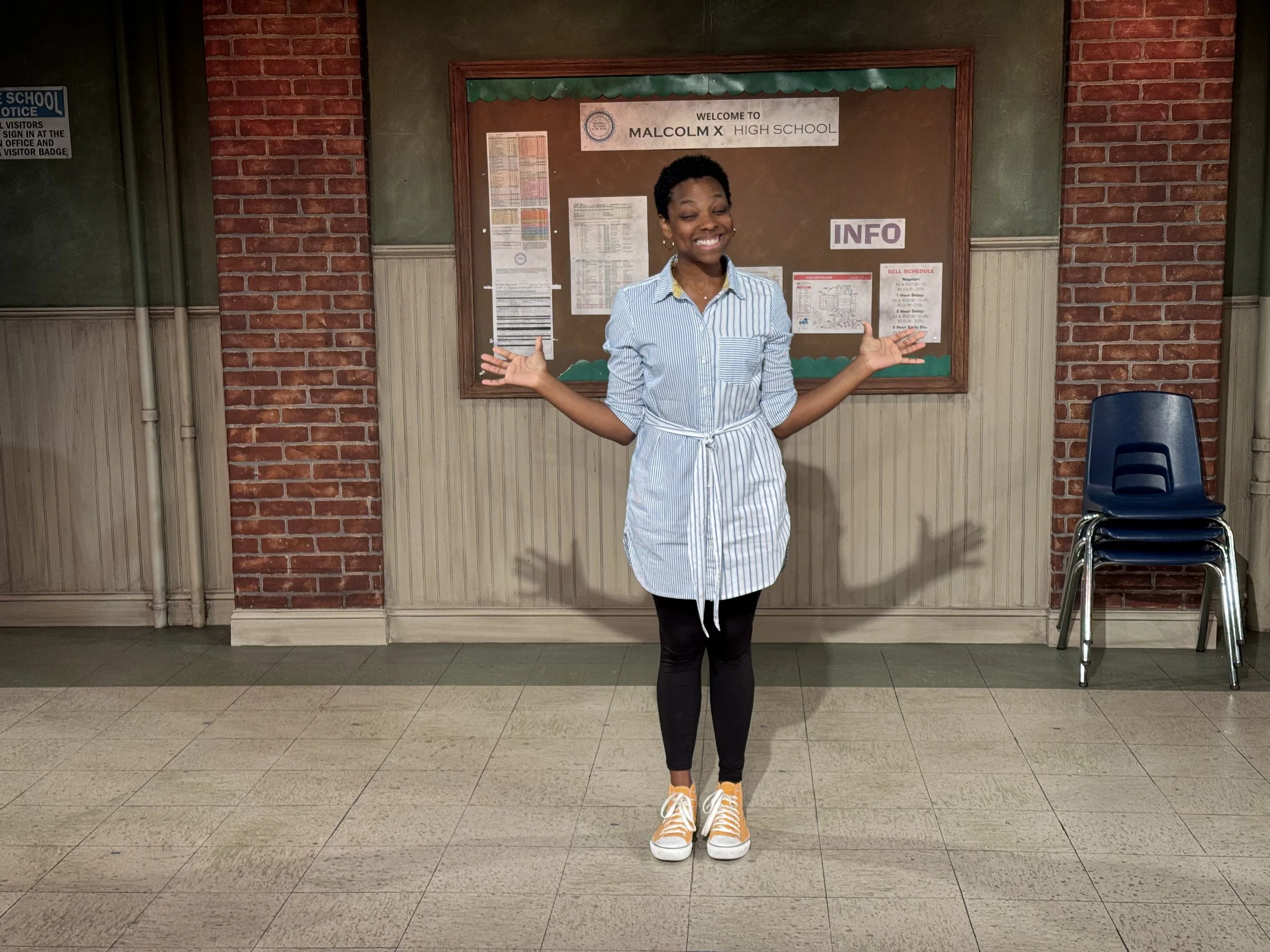
Flynn-McIver has assembled a team of designers who use a few well-chosen touches to bring the school to life. Scenic designer Michael Amico’s tile floor looks like Janitor Baron has been hard at work with his broom; CJ Barnwell’s lighting design subtly suggests changes of scene and time, and Bailey Gafeney’s sound effects quietly evoke the world of the school beyond what we see.
Costume designer Mary Evelyn Gunn puts her leading lady in a light blue-and-white striped wraparound dress with dark tights. The outfit is a cool neutral against Amico’s warm beige beadboard paneling and red brick back wall. You know Gunn knows her stuff by the orange and white sneakers she gives her star — a pop of color for a perky lady named Sun.
The title No Child . . . is a direct echo of the No Child Left Behind Act, a controversial federal education policy championed and signed into law by President George W. Bush in 2002. It promised accountability and equal opportunity for all students in all schools. But the playwright’s ellipsis questions that promise. She doesn’t sermonize; she just shows us what actually goes on.
In the play’s finale, Janitor Baron, now speaking from the afterlife, like the patient graveyard inhabitants in Our Town, tells us what has happened to Ms. Sun and her students. It’s one last turn of the kaleidoscope that lands with surprising humor and optimism.
No Child . . . runs through May 17. For tickets and more information, visit ncstage.org.
(Photo courtesy of NC Stage Co.)