
Little Shop of Horrors at Asheville Community Theatre
For the opening of its 80th anniversary season, Asheville Community Theatre has pulled out its colorful paint box, pulled together a cast of America's-Got-Talent-level voices, and pulled off some slick stage magic, all in service of a horror-film musical spoof with a real heart of darkness.
In their 1982 Off-Broadway hit Little Shop of Horrors, Howard Ashman (book and lyrics) and Alan Menken (music) turned a 1960s B-movie flick by horror schlockmeister Roger Corman into a witty parody of sci-fi creature features and sell-your-soul-to-the-devil parables. They gave it an irresistible pastiche of early rock ’n’ roll, doo-wop, and Motown girl groups, with playful echoes of Broadway musicals, including Sweeney Todd and Fiddler on the Roof.
The show begins as a seemingly light-hearted romp in the seedy Skid Row section of downtown New York City in the early 1960s. Our hero, Seymour Krelborn, is a timid, accident-prone clerk in the failing Mushnik's Flower Shop. He has a crush on his fellow employee, the sweet, ditsy Audrey, who is much abused by her sadistic, motorcycle-riding dentist boyfriend Orin Scrivello.
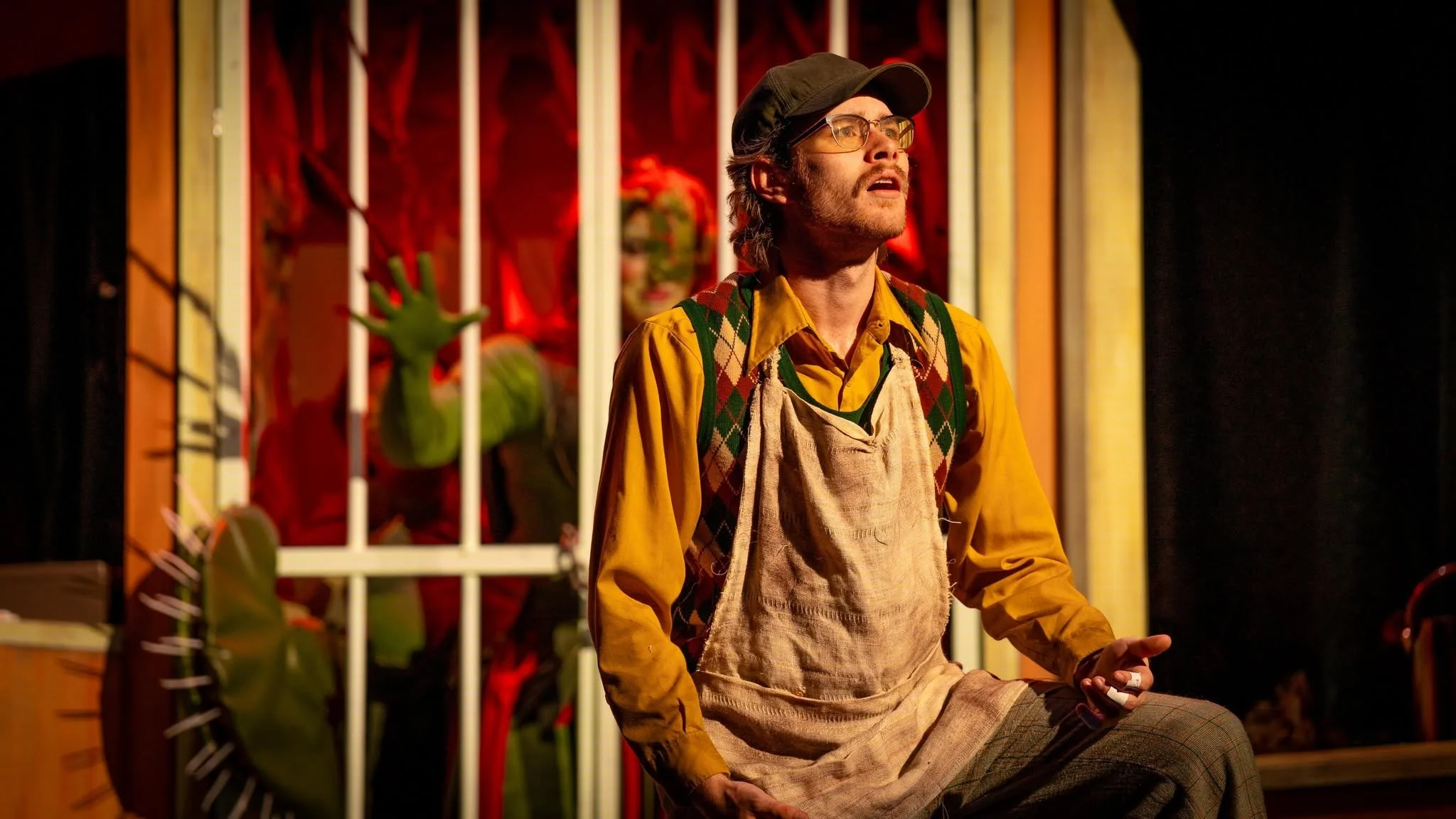
In his ACT debut, Nathaniel Ogden makes for an endearing, perpetually hunched Seymour, a stereotypical nerd in a retro argyle sweater vest. Candy Macan-Egues, a lovely Ermengarde in ACT's Hello, Dolly!, is his bruised sweetheart. On the Sept. 18 opening night performance, when they teamed up for their love duet, "Suddenly, Seymour," this nerd and ditz combo soared and earned cheers from the audience.
Jon Robinson as Orin oozes smarm, and his wild cackle when high on laughing gas is infectious
During a solar eclipse, Seymour visits the wholesale flower district and buys a strange little plant that looks like a Venus flytrap. He names it Audrey II in honor of his unrequited love. When he puts the exotic oddity in the shop window, it immediately draws a curious customer, then more and more flower-buying customers, until the shop is thriving.
Ogden garnered additional cheers alongside Stephen Nix’s shop owner Mushnik when they performed "Mushnik and Son," a boisterous song-and-dance in which Mushnik offers to adopt Seymour to keep him and his moneymaking plant from getting away. It's a massive mash-up of tango and bolero, with sly inflections of klezmer and hora from Fiddler's "L'Chaim."
Audrey II is droopy in its little coffee can until Seymour accidentally pricks his finger and discovers the plant has a taste for human blood. As it gets bigger and bigger and bigger, Seymour becomes a local celebrity. While his taste for fame grows, Audrey II's appetite grows insatiable and demands more than Seymour’s ten fingers can provide.
Little by little, Seymour becomes complicit in death, until he is a knowing accomplice to murder. It's a bargain with evil he can't refuse.
One of Ashman’s and Menken's cleverest devices is a trio of backup singers — Crystal (Audrey Redfern), Ronette (Kayla McLamb), and Chiffon (Niamah "Nemo" Coleman) — who function like a Greek chorus. They snap and jive with precision and panache to Elaina Zwiener's choreography while slyly commenting on the fates of the protagonists. They rightly take center stage in the show’s finale, “Don’t Feed the Plants.”
Director Dwight Chiles keeps the action moving briskly on Jill Summers's mobile set, which cleverly takes us in and out of Mushnik's shop, the dentist's office, and even accommodates Audrey II's appetite for devouring entire human beings. Marilyn Bailey's costumes — in a lovely palette of muted burgundy, navy, blue, mustard, tan, and green — are a visual feast, even if they may be a little too clean and well pressed for Skid Row.
Of course, the real star of Little Shop is Audrey II, and it takes a team of magician puppeteers — I counted eight names in the program — to bring it to monstrous life, starting with Lucien Hinton, an experienced Disney Imagineer, who is credited with its design. Take a look at other Audrey IIs on the internet and you’ll appreciate the originality of his design.
And casting the imposing Sue Greene, who played Frank-N-Furter in ACT’s Rocky Horror Show, as the face and body of Audrey II is inspired. This is an actor who gives outsized characters their full wallop.
Does Little Shop of Horrors have any significance beyond a top-notch evening’s entertainment? Culture observers thought Corman’s 1960 film might have captured Cold War fears of the atomic bomb and Russian missiles, while Ashman and Menken may have implied a capitalist critique: the man in the grey flannel suit meets Gordon Gekko’s “greed is good” M.O. Today’s audiences might think about how the tentacles of social media threaten to engulf us.
For this viewer, however, artificial intelligence was top of mind. “Don’t feed the plants,” this musical warns. In 2026, perhaps it means, “Don’t feed the algorithm.”
Little Shop of Horrors runs through Oct. 11 at Asheville Community Theatre. For tickets and more information, visit ashevilletheatre.org.
(Photo courtesy of Asheville Community Theatre)