
Interview: Joe Westerlund (Setting)
Any song that drummer Joe Westerlund plays on is always intriguing.
A veteran of the experimental music world through his membership in Megafaun, Watchhouse, and DeYarmond Edison, as well as an in-demand session player, he reliably provides complex yet engaging percussion parts to an ever-growing body of work.
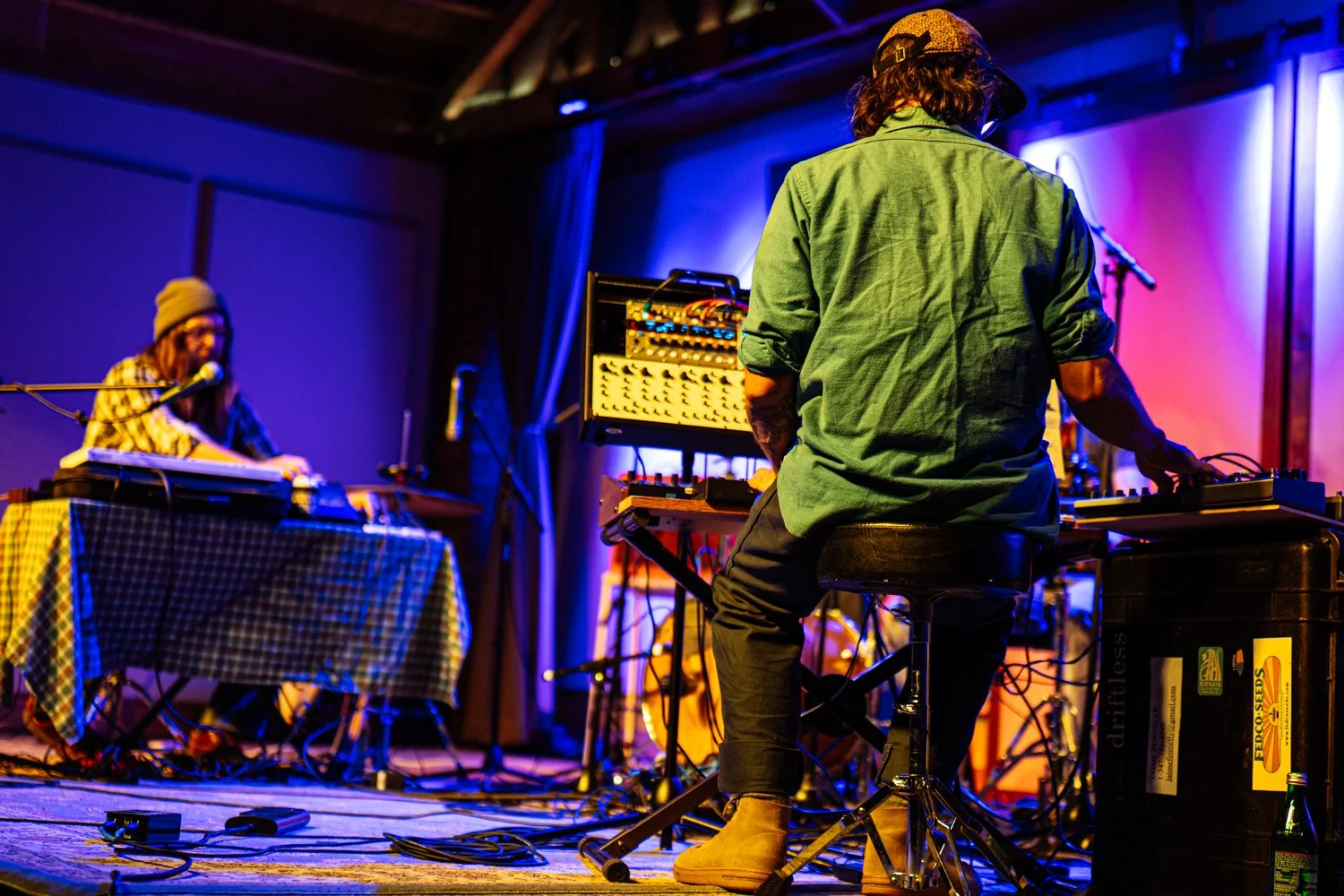
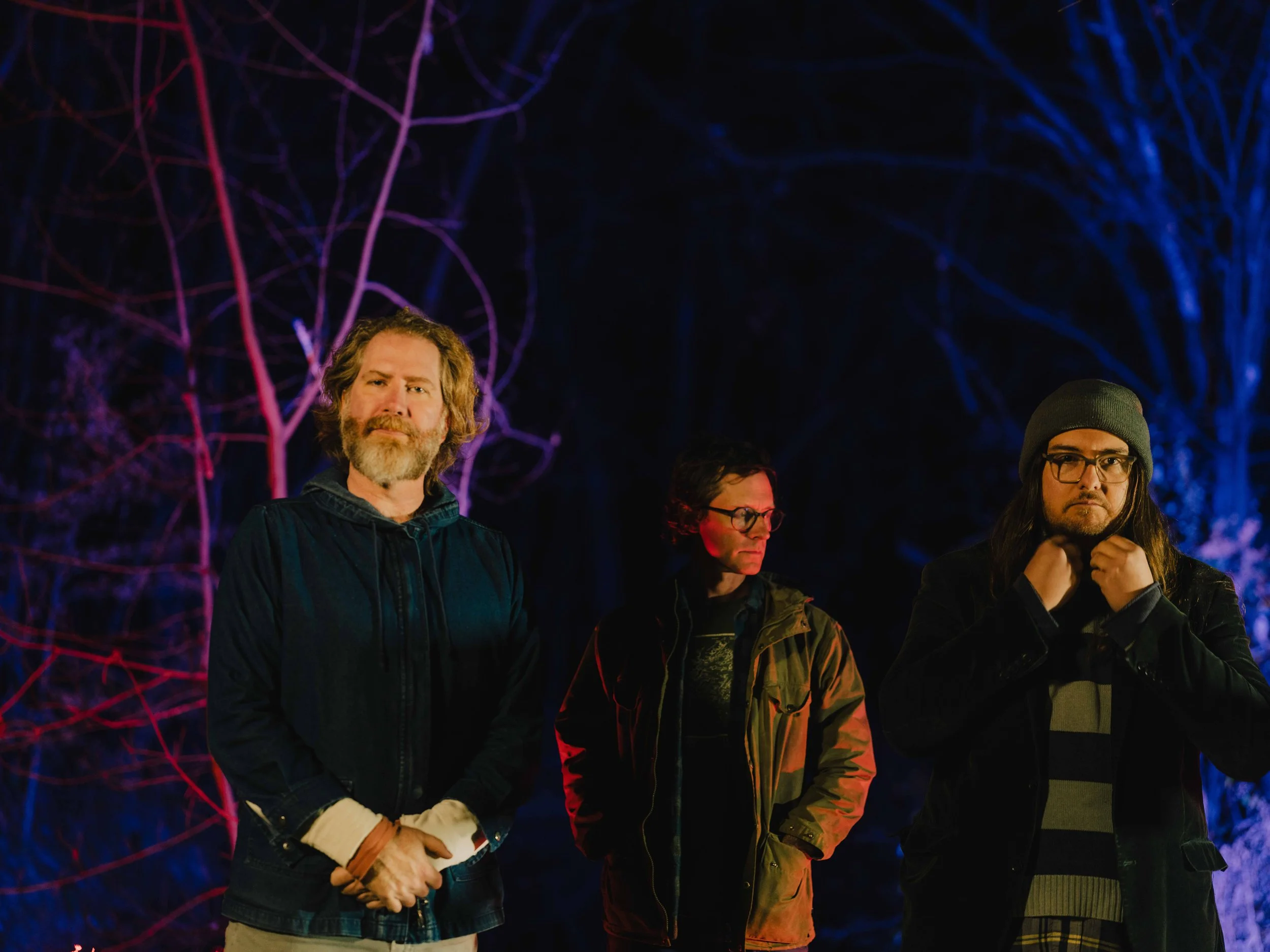
Westerlund is also one-third of Setting, the improvisational, instrumental band based in Durham, alongside Nathan Bowles (keyboards, banjos, tapes, percussion) and Jaime Fennelly (synthesizers). The members of Setting are no strangers to Asheville, having performed here numerous times in various musical configurations, including as Setting, which has officially released two live albums captured from shows in Western North Carolina. The band is about to issue a new self-titled studio record, recorded at Asheville’s Drop of Sun Studios.
Issued by the legendary Chicago label Thrill Jockey Records and produced by Setting alongside co-producer, engineer, and mixer Adam McDaniel, Setting once again shows how much the trio prefers a big canvas. The album features long songs, such as the swirling “Heard a Bubble”; the intense, Tortoise-like build that makes up “Ribbon of Moss”; and is capped off by the grand, doom-y, banjo-and-zither-centered groove within “Derring-do.” The record also expands the group’s sound with the thick, gooey, off-kilter funk of “Gum Bump.” Setting is a band in full command of its powers.
In addition to Setting and his work in other bands, Westerlund has also released a series of solo albums, including last year’s Curiosities from the Shift. While Setting attempts to explore every aspect of one tone within a track, the quantity of shorter songs on Curiosities is less slow burn and more instant flame.
In the lead-up to the release of Setting and prior to the band’s Saturday, May 16 performance at AyurPrana Listening Room, Asheville Stages spoke with Westerlund about recording the new record, the band’s communication after sets, Setting’s influence on his solo work, and more.
Scott Bunn: This is Setting’s second studio album after a series of releases documenting your live performances. What’s the importance of a studio album for the band?
Joe Westerlund: Yeah, that's a good question. Well, it's been evolving between the first two [records] quite a bit. The first one — we went into the studio having played together a lot, but we didn't have a plan for what we wanted to record. We knew we wanted to capture some improvisations in a studio and [create sounds in the studio] that we couldn't with just a live performance. At that point, we hadn't ever played in front of people, actually.
Because we toured on the last record, there's been two or three phases of live performance where we got into a groove of exploring certain modes. Right after we recorded that first record, some of those modes felt like they were referential to the first record. And then new ones started emerging. There were two or three different phases within us playing off of that where we felt like we had new material, and we released live recordings of those. We still have more in the vault that we could be releasing. There's always rabbit holes that emerge in the moment — even if some of them feel like they're building on past performances, there's always some new angles that emerge, naturally.
With all that information, we started having rehearsals together, which consisted of improvisation. And we wanted to be prepared to do something a little bit different for the second record. From those rehearsal tapes, Jaime took a lot of the ideas and made them into sequenced synthesizer material and brought those to the studio. We, as a trio, had
these maps for each of the sequences that we developed just through playing. A lot of what we do, there's less singular composition or one person writing all of it. It really emerges through us playing stuff together. But like I said, Jaime had these things that we had worked out together. And Nathan and I built parts off of it. Jaime, himself, built parts off of the sequences, and we did a lot more carving out and a lot more collective overdubbing [of] extra parts.
A major difference of this second record is working with Adam McDaniel at Drop of Sun, and the entire process of making the record happened there. Throughout the whole process, even in the very beginning of doing the initial tracking, Adam was mixing for/with us. That's the other part of it that was different: pretty much everything on this record had takes. For [Shone a Rainbow Light On], it was like, “First time, best time. Leave it alone. Don't try to touch it too much.” But for this, we’d get to take three, and Adam would be like, “Why don't you guys take a break for a second? Let me do some editing the way that I hear it. If you don't like it, we can just do another take. But let me just carve this one out.” I think that one was “Gum Bump.”
SB: I wanted to specifically ask about “Gum Bump” because it's downright funky, and that's not a word I would have ever thought to use with a Setting track before. Can you talk about the evolution of that song?
JW: Well, that was really interesting because Jaime always had that bassline. Every day, during the initial tracking session, we'd run Adam until he was spent and done. We'd take a dinner break, send him home, and then the three of us would usually prepare what we were going to do the next morning. And “Gum Bump,” as far as us kind of hammering it out — especially with the drum part — had the most evolution out of all of [of the tracks on Setting].
I definitely got to a point where I was doing “Funky Drummer,” snare-hat-kick kind of thing, in order to find the foundation of what rhythm was supposed to accompany that bassline. We all felt like we were on the same path with it. We kind of acknowledged that we were pushing it into that funky zone to an extent that might not feel great in the long run; that there is probably a more authentic-to-us, a more creative solution to find in what textures we wanted to explore with that kind of funky, rhythmic, almost backbeat-like mode.
SB: But you still do it in the context of Setting. It's not like, “Now we're sounding like James Brown.” It's Setting’s version of that, which makes it sound really cool and unique.
JW: I think part of the solve was finding the coordination — what the actual rhythmic accompaniment was — and then replacing the sounds with things that felt more like what I've been exploring normally, which is more rounder sounds, palms and assorted percussion instruments. I laid some gongs on the table and muted them a little bit. Instead of playing hi-hat with my left foot, I'm playing an open tom. And so it has more of a tonal drum center than a James Brown, “Funky Drummer” thing. I felt good about that, personally; but also, I think preserving the path that Setting had already been on felt like the more creative solution.
Nathan has not only banjo, but he fills in a lot with percussion as well. He always has, but it's becoming more and more prominent. And also, his keyboard playing has gotten more rhythmic. I think “Gum Bump” sort of opened the door for that to happen more. I'd say that about the three of us in general: we're getting less drone-y, moving more into an active rhythmic ensemble altogether, especially with Jaime’s move from harmonium to a full synthesizer rig. He has so much command over all the textures now. They're long notes still [as with a harmonium], but more often it's moving into a more active, rhythmic space. I think it mirrors the sequences that he's bringing and creates the foundation for a lot of these pieces.
SB: I see a lot of similarities between Setting and The Necks. I interviewed The Necks for Aquarium Drunkard a few years back and asked them this same set of questions which work for Setting as well: What's the communication between the three of you after a set or a performance? Do you critique yourselves? Do you go back and listen to the tape? How does that differ with studio recordings?
JW: We don't listen to the tapes together, but we do talk about it, especially when we're doing the live releases and checking masters. I’ve always found that it's helpful to listen to something later, not to be jumping offstage and being like, “We’ve got to listen to this tomorrow.” We've rarely listened to anything together to follow the little ant farm squiggles of all the decisions that we're each making in the moment — “I don't know about that one!” Or “That was cool.” Right after we're done, it's usually like, “That felt great.” Or “This part felt a little bit loud.”
I say this over and over again, so I know I'm a broken record with my friends with it, but there's a really amazing Jerry Garcia quote in The Grateful Dead Movie where he is talking about being really upset about a performance, to the point of harming Phil Lesh, I think it was, because he was just so angry about it. And then they listened back to the tapes a month or two later, and that became Skull and Roses, or one of their seminal live records. His quote is like, “I realized that there wasn't a connection between my experience and what the music ended up sounding like.”
I think we're always really cautious, unless something goes terribly wrong — which it hardly ever has — to get too critique-y about any part of a performance, or any single performance. Your experience with it hardly ever correlates with anyone else's experience, especially when you're the one making it. We point out things we liked, or things that hadn't happened yet. That's always really exciting for us. “It felt like maybe you were referencing ‘Heard a Bubble.’ We weren't playing that anymore. We had moved on.” We talk about things like that, the identifiers of what the math was in each of our minds, just so we know that we're understanding each other's intentions. That’s always a really exciting conversation.
SB: We’re doing this interview for Asheville Stages and Asheville plays a big part in the Setting story. Two of the three live releases documented performances in Asheville and this new album was recorded at Drop of Sun Studios. Can you talk a bit about your experience at Drop of Sun and what is it about Asheville that keeps the band coming back?
JW: Totally. There's been great energy coming at us from Asheville between Bryce Franich at AyurPrana Listening Room and Adam McDaniel [at Drop of Sun]. They've been so good to us and so enthusiastic about what we're doing. One more Asheville person who's been instrumental in Setting planting roots in WNC: Jeff Arnal. I've known Jeff since my Bennington [College] days, and he's a fellow student of Milford Graves. He invited us to perform Setting's first show in Asheville at Black Mountain College Museum, which we turned into our first live release.
I'd say that they've been the main catalysts, but I've always had so many ties to Asheville. I've played in The Dead Tongues for a while, previous to Setting starting up, so I've always had a tie, but I've always felt that it was not necessarily a very strong tie. This could just be me, but I do feel that sometime in the last few years, the Asheville music community seemed to have more of a center. It seems like there's a tighter community forming. I could be totally offending someone and be totally way off with just an outsider perspective.
There's been some really exciting bands that have been coming out of Asheville the last five or six years. You feel that, too, in the wake of [Tropical Storm] Helene as well. I was touring with The Dead Tongues when Helene hit and just to see the way that the community pulled together — watching the network and the way everybody started communicating after that in response, it seems to have skyrocketed the community connectivity.
SB: Yes, all of that is accurate! I want to ask you about your solo album from last year. How does playing with Setting influence your solo work?
JW: I think there are definitely elements that I try to keep different [between the two]. I think in making [Curiosities from the Shift], it has 12 tracks on it; they’re pretty short. There's a little bit more desire to present some of those pieces in their simple song form. I think it would be cool to perform that record, front-to-back in a live performance. But it would take a lot of people and resources to pull it together because there's just so much overdubbing. I think it would take at least two or three percussionists alone.
It's kind of how I've always done things. Even back to my Megafaun days, that was always the process: make the record you want to make and then figure out how it makes sense to present it live with what you have. I've definitely taken more than one cue from Setting in terms of, if it is a scenario in which it's just me [performing], I'm going to stretch it out. It's been very helpful to have the [the songs as] launching pads of melodic content because those are the things that become the guideposts for complete malleability. I always find that to be helpful.
Setting has definitely encouraged me to take these three-minute tracks and let myself explore them and find new moments in them that don't exist on the record and to not be afraid of the long-form as a solo performer. I think it's more comfortable to be like, “OK, I'm gonna play this song. Done. The next thing: done.” There's a lot more risk involved for me to be like, “I'm going to provide a ride for people to choose to get on or not.” That's really the way that the solo thing operates. For me, the solo vehicle is just about being open to implementing new ideas into it. They really are malleable songs that I want to continue to explore in ways that I actually hadn't dreamed of before.
This interview has been edited and slightly condensed.
IF YOU GO
Who: Setting
When: Saturday, May 16, 7 p.m.
Where: AyurPrana Listening Room, 312 Haywood Rd., ayurpranalisteningroom.com
Tickets: $21.49
(Photo by Graham Tolbert)